
By Dylan Beardsley October 5, 2026
Guests form their opinion of an event before they enter the building. A wedding guest who spent twenty minutes circling for a space arrives flustered. A conference delegate who could not find the entrance from the car park misses the opening session. A gala attendee who waited forty minutes in a valet queue at the end of the night remembers that, not the speeches. Arrival and departure bracket the entire experience, and they are the parts most likely to be left to chance because they happen outside the room where the event is being planned. Getting event venue parking valet arrangements right is rarely about adding capacity, since most venues cannot, and almost always about managing flow, information, and timing.
Why Arrival Causes More Problems Than Capacity Suggests
Most parking failures are concentration problems rather than shortage problems. A venue with two hundred spaces and two hundred guests should work, until every one of those guests arrives within the same twenty minutes because the invitation said seven o’clock. The same car park handles a shopping centre’s two hundred customers without difficulty because they arrive across eight hours. Events compress demand into a narrow window at both ends of the evening, and departure is worse than arrival because everybody leaves at once rather than trickling in.
Layer on guests unfamiliar with the location, driving in the dark, following a satellite navigation instruction that points to the wrong side of the building, and the queue forms from confusion as much as from volume. The practical consequence is that staggering arrival, signposting clearly, and managing the exit are usually more effective than finding extra spaces.
A useful arrival plan usually looks at a few simple things:
- When the first guests are likely to arrive, not just the official start time.
- How many vehicles could reach the venue during the busiest 15 or 30 minutes.
- Which entrance drivers are likely to use first.
- Where cars, taxis, rideshare vehicles, pedestrians, and deliveries could cross paths.
- What happens if the main car park reaches capacity.
Even small changes can make a noticeable difference. If an invitation says doors open at 6:30 and the programme starts at 7:00, guests naturally spread their arrival. If everyone is told to arrive at exactly 7:00, the car park has to absorb that decision.
How Do You Work Out What Parking You Actually Need?
Start from guest count and work through realistic assumptions rather than applying a general ratio. The variables that matter are how many guests will drive, how many will share a vehicle, how many will arrive by rideshare or taxi, how many will use public transport, and whether any are staying on site.
Those proportions differ enormously by event type and location. A suburban wedding may see most guests driving with two or three per car. A city conference may see a majority arriving by transit or rideshare. A corporate dinner at a hotel may have half the attendees already staying there. The table below shows the kind of planning assumptions worth making explicit rather than leaving implicit.
| Event Type | Typical Driving Share | Occupancy Per Car | Planning Note |
| Suburban wedding | High | 2 to 3 | Peak arrival within 30 minutes |
| City conference | Lower | 1 to 2 | Transit and rideshare significant |
| Corporate dinner at a hotel | Mixed | 1 to 2 | Many guests resident on site |
| Community or charity event | High | 2 to 4 | Families arrive together |
| Trade show | High | 1 to 2 | Exhibitor vehicles need separate space |
| Evening gala | High | 2 | Simultaneous departure is the problem |
Build in contingency for staff, vendors, speakers, and exhibitors, since those vehicles arrive earliest, stay longest, and are frequently forgotten in the guest calculation.
It is also worth separating different types of parking instead of treating every space as interchangeable. A caterer’s van, an accessible vehicle, a guest’s car, and a rideshare vehicle have very different needs. Reserving the most convenient spaces for vendors may seem practical during setup, for example, but those spaces can become a problem once guests start arriving.
When Does Valet Parking Make Sense?
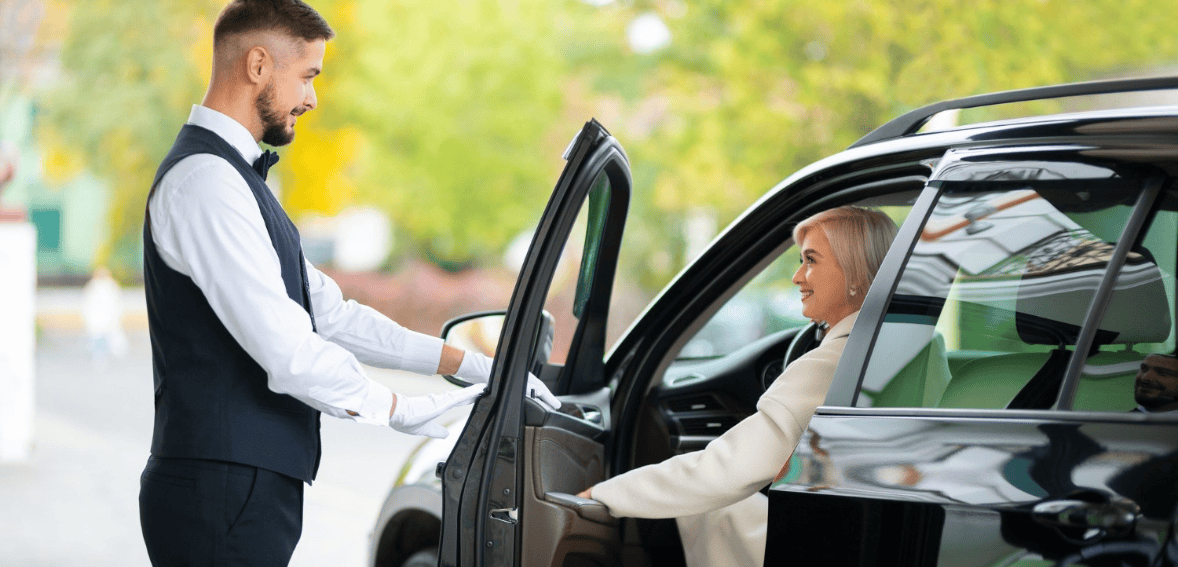
When the arrival experience is part of the product, when parking is genuinely difficult, or when guests will be dressed for an occasion and walking distance matters. Valet solves three problems at once. It removes the search for a space, which is the main source of arrival stress. It increases effective capacity, because valet attendants can stack vehicles far more densely than self-parking guests. And it delivers a sense of occasion that suits weddings, galas, and premium corporate events.
The costs are real though. Valet is charged per attendant per hour with a minimum staffing level, so a small event pays a disproportionate amount. It requires a drop-off area with enough space for several cars to queue without blocking traffic. It needs secure key handling and appropriate insurance. And it creates a departure bottleneck if under-staffed at the end of the night, which is where most valet complaints originate.
Before choosing valet, check a few practical points:
- Is there enough room for vehicles to enter, stop, hand over keys, and move on without blocking the road?
- Can the valet team store and organise keys securely?
- Where will retrieved vehicles wait before being handed back to guests?
- Who is responsible if a vehicle is damaged?
- Does the provider have appropriate insurance?
- How long will attendants remain after the official event end time?
Where budget is limited, valet at arrival with self-collection at departure is a compromise worth considering, though it needs explaining clearly in advance.
How Should Valet Be Staffed and Scheduled?
With more attendants than the average suggests, because the average is irrelevant and the peak is everything. Valet staffing is usually quoted on vehicle volume, but the number that matters is how many cars arrive in the busiest fifteen minutes and how many depart in the busiest fifteen minutes.
Departure is harder than arrival, since retrieving a stacked vehicle takes longer than parking it and every guest wants their car immediately. Practical measures that reduce the departure queue include taking ticket requests before guests reach the door, so cars are being retrieved while people collect coats, positioning a podium inside the venue for that purpose, texting guests a link to request their vehicle, and staging frequently requested cars closer as the evening progresses.
Agree the finish time with the valet provider realistically, since a contract ending at eleven when guests leave at midnight produces either overtime charges or abandoned guests. Confirm who holds liability for vehicle damage and that the provider’s insurance is current, in writing, before the event.
It can also help to think of valet as two separate operations rather than one. Arrival is about getting vehicles off the road quickly. Departure is about getting people and vehicles reunited without creating another queue.
What Does Rideshare Drop-Off Require?
A designated location, communicated in advance, that does not conflict with the main entrance or the valet lane. Rideshare has changed event arrival fundamentally, and venues that have not adapted suffer predictable problems. Drivers stop wherever their app directs, which is often the building’s registered address rather than the correct entrance, creating congestion at the wrong point. Guests stand in the dark trying to identify their vehicle while six identical cars queue. Departure produces a cluster of waiting drivers and confused passengers.
The fixes are straightforward once the problem is recognised. Designate a specific rideshare zone with clear signage, away from the valet lane. Communicate the exact drop-off address to guests in advance, including any instruction to use a side entrance or a specific pin location rather than the venue name.
Set up a corresponding pickup point for departure, staffed if the event is large. Some venues now provide a named location within the rideshare apps themselves, which is worth arranging with the platforms if you host events regularly.
The rideshare area should also be easy for guests to identify on foot. A pickup point hidden behind a loading dock may technically work, but it is not especially useful when dozens of guests are leaving after dark.
Who Pays for Parking at an Event?
A negotiation point that should be settled in the contract rather than discovered on the night. Venues handle this in several ways, including free parking included in the hire, validated parking where the host covers the cost per vehicle, discounted event rates guests pay themselves, full-price guest payment, and valet charged either to the host or to the guest.
Each has consequences for the guest experience and for the budget. Host-paid parking removes friction entirely and is worth the cost for weddings and premium corporate events where the impression matters. Guest-paid parking is normal for conferences and public events and causes no complaint provided the cost and payment method are communicated in advance.
What reliably generates complaints is a surprise, meaning guests who arrive expecting free parking and encounter a charge, or who find the machine takes card only when they have cash.
Settle this at contract stage, confirm the arrangement in writing, and communicate it in every piece of guest information.
What Needs to Be Communicated to Guests Before They Arrive?
More detail than feels necessary, because a guest reading it in advance will arrive calmly and one who did not will arrive late. The information that prevents problems includes the exact address to use in navigation, which is sometimes not the venue’s main address, the entrance guests should use, where to park and whether valet is available, the cost and payment method, the rideshare drop-off point, accessible parking locations and the route from them to the entrance, public transport options with the nearest stop, and how long to allow between parking and the event start.
A simple arrival note can cover most of the questions guests are likely to have:
- Driving: Exact navigation address and preferred entrance.
- Parking: Location, cost, payment method, and whether parking is reserved.
- Valet: Where to enter the valet lane and whether the service is included.
- Rideshare: Exact drop-off and pickup point.
- Accessibility: Accessible parking location and the easiest route to the entrance.
- Public transport: Nearest stop and approximate walking time.
- Timing: How early guests should arrive before the programme begins.
Send this with the invitation or registration confirmation, repeat it in a reminder a day or two before, and put it on a dedicated page on the event website rather than buried in an email. Including a simple map or an image of the entrance helps considerably, since guests recognise a photograph faster than they interpret a map. For large events, a short video driving the approach route is unusually effective.

How Do You Handle Overflow and Shuttles?
By arranging it in advance rather than improvising when the main car park fills. Overflow options depend on the location and are worth researching early, including agreements with nearby businesses whose own car parks are empty in the evening, such as offices, schools, churches, or retail units, and commercial car parks within walking distance.
Any such arrangement needs permission in writing, confirmation of insurance and liability, and clarity about hours. Where the overflow is too far to walk, a shuttle becomes necessary, which introduces its own planning requirements including vehicle capacity, frequency, clearly marked pickup points at both ends, and staffing to direct guests.
For an overflow arrangement, confirm:
- Who has permission to use the additional parking area.
- When the area opens and when it must be cleared.
- Who is responsible for lighting and security.
- How guests will get from the overflow area to the venue.
- Where shuttle vehicles will wait without blocking other traffic.
- What happens if the event runs later than planned.
Shuttles are also the answer where parking is genuinely insufficient regardless of overflow, and they work well for large conferences and festivals. Communicate shuttle timings precisely, run them more frequently at the start and end than in the middle, and keep the last departure later than the event officially finishes, since the guests who linger are the ones most likely to complain about being stranded.
What Are the Accessibility Requirements?
A legal obligation rather than a courtesy, and one with specific technical requirements. Accessible parking spaces are governed in the United States by ADA standards, which set out the minimum number of accessible spaces based on the total in the car park, the proportion that must be van-accessible, dimensions for the space and the adjacent access aisle, and requirements for signage and an accessible route to the entrance.
For events, several practical points go beyond the minimum count. The accessible route from parking to entrance needs to be genuinely usable, meaning lit, level, and clear of temporary obstructions such as cabling, marquee pegs, or vendor deliveries. Accessible spaces must not be used for staff, vendor, or valet staging, which happens frequently and is both unlawful and avoidable.
Where valet is offered, it should be available to all guests rather than being an obstacle for someone who needs their own adapted vehicle nearby. Communicate accessible arrangements in advance so guests can plan, and have a named staff member responsible on the night.
What Should the Site Plan Cover?
Everything that moves on arrival day, drawn rather than described, because a drawing exposes conflicts that a list conceals. Mark the guest arrival route and entrance, the valet lane and staging area, the rideshare drop-off and pickup zones, accessible parking and the route to the door, staff and vendor parking, the loading area and delivery route, the overflow location and shuttle stops, emergency vehicle access, and any road closures or restrictions.
A useful site plan should clearly show:
- Guest vehicle routes and the main pedestrian route.
- Valet entry, waiting, parking, and retrieval areas.
- Rideshare and taxi drop-off and pickup points.
- Accessible spaces and the complete accessible route.
- Vendor, staff, and exhibitor parking.
- Catering and delivery access.
- Overflow parking and shuttle stops.
- Emergency access routes that must remain clear.
Then walk it, ideally at the same time of day the event will run, because a route that works at two in the afternoon may be unlit and ambiguous at seven in the evening. Share the plan with the venue, the valet provider, the caterer, the AV team, and your own staff, since most arrival chaos comes from two operations occupying the same space at the same time.
Keep a copy at the door on the night with a named person responsible for arrival, which is the role most often missing and the one that resolves problems before guests notice them.
How Can You Reduce Problems After the Event?
Departure deserves its own plan rather than being treated as the natural end of the arrival process. Once the programme finishes, hundreds of people may move towards the same exit within a few minutes. Some will look for their cars, some will request rideshare vehicles, some will wait for family members, and others may still be inside collecting belongings.
A few simple arrangements can make that period easier:
- Keep clear signs showing the route to self-parking and rideshare pickup.
- Have staff available near the exit rather than leaving guests to work it out themselves.
- Begin valet retrieval before the formal end of the event where possible.
- Keep lighting on across parking and walking routes.
- Make sure shuttle services continue after the main programme ends.
- Keep emergency and service routes clear even after guests begin leaving.
The last impression can be just as noticeable as the first. A smooth departure does not need to feel elaborate. It simply needs to feel like somebody thought about what would happen when everyone was ready to go home.
Final Thoughts | Event Venue Parking
Parking and arrival planning is mostly about anticipating where people will hesitate, turn around, queue, or ask a question. Good signage, realistic staffing, clearly separated traffic flows, accessible routes, and early communication can prevent many of the problems that otherwise appear on event day. The goal is not necessarily to create more parking. It is to make the parking, valet, rideshare, and departure process feel simple to the people using it.