
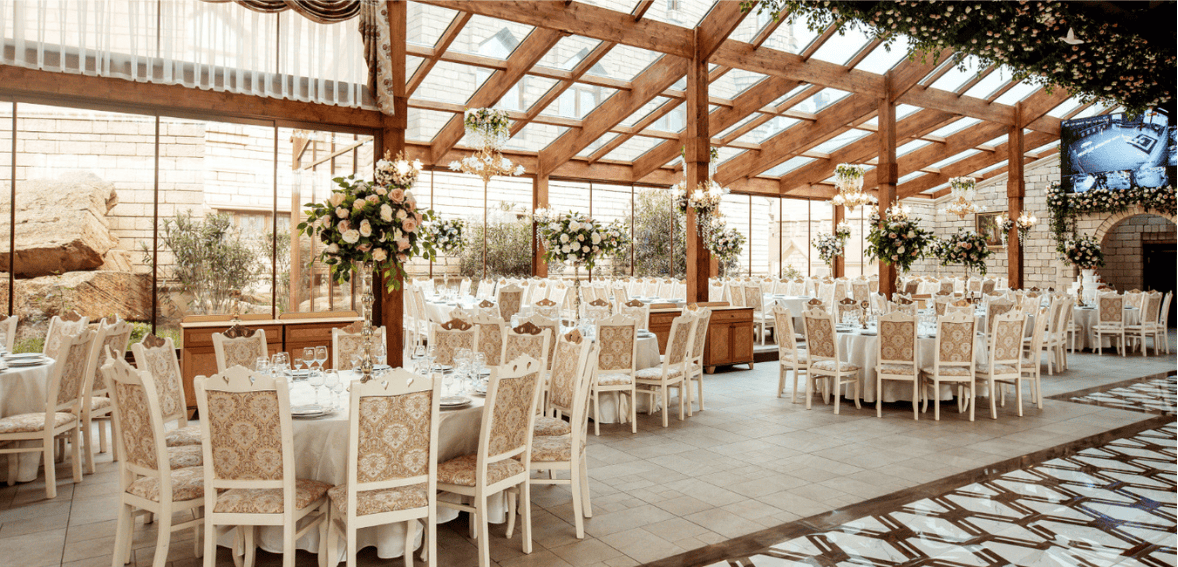
There are 52 Saturdays in a year, and a venue selling only the good ones works with about half of them. Every wedding venue business plan is an argument about what happens on the other 300 days.
Written for the owner costing out a barn, a farm building or an empty commercial shell before committing capital: what a lender needs the plan to prove, what the build costs, how revenue stacks up across peak and off-peak dates, and how many bookings a year the numbers need.
What a Wedding Venue Business Plan Has to Prove
Anyone working out how to start a wedding venue business meets the same four questions, and a plan for a wedding venue business is read for those answers rather than for its other sections.
First, that the site can legally hold events at the capacity assumed. Capacity drives everything downstream, and a plan built on 200 guests that a septic system, parking count or occupancy classification caps at 120 is a different business, not a smaller one.
Second, that the build-out number is real: a sourced range with a stated contingency reads differently from a single unexplained figure.
Third, that the booking assumptions survive a calendar. Peak Saturdays are finite and every competitor within an hour sells the same ones, so a plan assuming 40 weddings a year has to show where dates 27 through 40 come from.
Fourth, that somebody has thought about the cash gap. Deposits arrive 12 to 18 months ahead, final payments days before, and the first full season is usually sold before the venue opens. A plan showing year-one revenue without showing when the cash lands is describing a different company.
A companion page for wedding venues covers the operational side once it is running.
How Much It Costs to Build or Convert a Wedding Venue
Ask how much does it cost to build a wedding venue and the honest answer is a range too wide to use until the structure type is settled. These are the published figures worth starting from.
| Cost item | Published range | Source and date |
| Barn built to wedding venue finish, per square foot | $50 to $170 | HomeGuide, on a page carrying no publication date |
| Metal or pole barn shell, per square foot | $15 to $40 | HomeGuide, undated page |
| Timber frame barn, per square foot | $50 to $100 | HomeGuide, undated page |
| Post and beam barn, per square foot | $60 to $160 | HomeGuide, undated page |
| General barn at 2,400 square feet, total | $60,000 to $240,000 | HomeGuide, undated page |
| Mid-scale restaurant build, per square foot | $350 to $600 | Claris Design Build, September 9, 2026 |
| Retail, shell to luxury fit-out, per square foot | $75 to $600 and above | Claris Design Build, September 9, 2026 |
| Warehouse and industrial, shell to specialized use, per square foot | $14 to $350 and above | Claris Design Build, September 9, 2026 |
Two things stand out. The barn figures sit on a page with no publication date, which matters more for construction costs than for most categories, so treat them as a starting point and get local quotes. And no published category covers event or assembly buildings at all: the September 2026 Claris breakdown runs through offices, retail, warehouses, healthcare and education without one, which is why venue costs get quoted off restaurant and warehouse comparables.
That gap is informative. A venue with a commercial kitchen, restrooms sized for 200 and a bar sits closer to the restaurant range; one where catering arrives in a truck and the kitchen is a prep room sits closer to the barn. Deciding which is being built is the first real decision in the plan, and it moves the number by hundreds of dollars a square foot.
Wedding venue startup costs also include items nobody publishes usefully. Land is the widest, with no reliable national figure, so the only sound method is three local comparables and a broker’s opinion in writing. Septic, well, power and road access on a rural site routinely cost more than the structure.
Revenue Model: Peak Saturdays, Off-Peak Days and Add-Ons
The revenue side has better data. The Knot’s Real Weddings Study read-out published May 6, 2026, drawing on 10,474 US couples married during 2025, puts average spending on a reception venue at $12,900.
That average hides the structure a plan needs. The same study reports $6,500 for weddings of 1 to 50 guests, $10,400 for 51 to 100 and $16,000 for 101 or more, with budget quartiles at $3,500, $10,400 and $24,800. State averages run from $27,710 in New Jersey down to $3,770 in Wyoming, so a plan using the national average in a state at either end of that spread is using the wrong number.
What the fee covers varies as much as its size. In the same study, 74 percent of couples said rentals were included in the venue cost, 41 percent said catering was, 37 percent alcohol, and only 7 percent said the fee covered the space alone. The $12,900 figure is therefore a bundled package rather than a site fee, and a plan comparing a bare rental rate against it is comparing different products.
Off-peak is where the plan is won. Friday and Sunday weddings, winter dates and midweek corporate bookings all sell at lower rates against the same fixed costs, and a companion post titled Filling Midweek Event and Off-Season Dates works through the demand side. Add-ons carry the margin: a food and beverage minimum rather than a flat rental converts catering and bar into venue revenue, explained in a companion post titled What Is a Food and Beverage Minimum, while ceremony fees, rehearsal dinners and extra hours do the rest. A companion post titled Pricing Event Packages covers how the bundles are built.
Booking Targets and Break-Even
Break-even is two numbers: annual fixed costs, and average revenue per event. The first comes from debt service, insurance, utilities, property costs and salaried staff. The second is local.
Worked against the published average, the math is quick. At $12,900 per wedding, covering $250,000 of annual fixed costs takes 19.4 weddings and $400,000 takes 31. Those are arithmetic on the study’s average rather than published break-even figures, and they ignore variable costs, so the real booking count is higher.
The calendar is the constraint that bites. There are 52 Saturdays, and in most regions roughly half fall in the season couples want, so a venue selling peak Saturdays alone works toward about 26 dates. At the national average that is $335,400, again arithmetic rather than a published figure. Any plan above that line is a plan to sell Fridays, Sundays and off-season dates, and should say so in words.
Three sensitivities belong in the plan: average revenue per wedding landing 20 percent below the local comparable, the opening season filling at half the assumed rate, common when the first year sells with no photographs or reviews, and the build running over, since the contingency and the opening date are the same conversation.
Is a wedding venue profitable? At a high enough booking count with catering and bar revenue captured rather than given away, yes. At peak Saturdays only, against a build financed at commercial rates, often not.

Staffing, Vendors and Policies
Most venues run lean and buy the rest: one salaried coordinator on sales and planning, one venue manager on event days, event staff hired per event, cleaning contracted out.
The vendor decision shapes the revenue model more than the staffing one. An open list is easier to sell and gives away the catering margin. A preferred list with an approval process keeps quality predictable and usually carries a commission. An exclusive in-house caterer captures the most revenue and needs a kitchen, putting the build back in the restaurant range.
Policies belong in the plan because they are financial decisions. Alcohol service, licensed in house or through a bar service, sets insurance terms and liability exposure. Vendor certificates, the damage deposit and the guarantee deadline for final counts all affect cash and risk, so state them rather than leaving them to the first contract.
On insurance, published figures exist only for adjacent businesses. Insureon, on a page last updated April 23, 2025, reports median annual premiums of $350 for general liability and $500 for a business owner’s policy among event and wedding planners who requested quotes through it, though the page calls the same figures medians in one place and averages in another. Those are planners rather than venues, so treat them as a floor and get three real quotes.
Permits, Zoning and Insurance (pattern level)
Requirements vary by state and county, often by township, so a plan should name the specific authorities rather than describe a general process. The pattern holds even when the details do not.
Zoning comes first and is the one that kills projects. Agricultural land is frequently not zoned for commercial assembly, and the fix is a conditional use permit, a special exception or a rezoning, each with a hearing, neighbors entitled to object, and a timeline in months. Checking it before buying land is the highest-value hour in the process.
Building and occupancy approvals follow. Assembly occupancy triggers requirements farm buildings do not have, covering exits, fire separation, restroom counts, accessible routes and parking, and bringing an existing barn up to that standard is where conversion budgets overrun.
Health, alcohol and noise permits sit on top. A kitchen needs health department approval, alcohol needs a state license or a licensed bar service, and outdoor amplified music is commonly limited by a noise ordinance whose cutoff time affects what the venue can sell. Insurance follows: general liability at the limits the lender and county specify, liquor liability where alcohol is served, property cover, and vendor certificates naming the venue as additional insured.
All of it changes across county lines. Get written confirmation from the planning office, the building department and the health department before the plan’s numbers are final.
Wedding Venue Business Plan Outline
Twelve sections, in the order a lender reads them.
- Executive summary: site, capacity, build cost, booking target and funding ask, in one page written last.
- The opportunity: local wedding volume, competing venues within an hour, their price points and what they do not offer.
- The site: location, acreage, existing structures, access, parking, utilities and the zoning position in writing.
- Build or convert: the structure decision, the cost range with sources, the contingency and the construction timeline against an opening date.
- Capacity and layout: seated and standing capacity, ceremony and reception spaces, the room turn, weather contingency.
- The offer: packages, what is included, the rental or minimum structure, and add-ons.
- Pricing: rate card by day and season, benchmarked against named local competitors rather than national averages.
- Booking plan: target events by day type and season for three years, with the first-year ramp stated honestly.
- Operations: staffing model, vendor policy, event-day process and the systems holding bookings, orders and invoices.
- Permits and compliance: the named authorities, the approvals needed, timelines and current status.
- Financials: build budget, three-year profit and loss, monthly cash flow showing deposit timing, break-even in bookings, three sensitivities.
- Risks: the five most likely, each with a mitigation and a cost.
Write the financials before the narrative. Sections the model cannot support tend to disappear on their own.
Frequently Asked Questions
How Much Does It Cost to Build a Wedding Venue?
Published barn figures run $50 to $170 per square foot for wedding venue finish, per HomeGuide on a page with no publication date. A build closer to restaurant standard tracks the $350 to $600 per square foot range Claris Design Build published on September 9, 2026. Land, septic, power and parking sit on top.
How Many Weddings a Year Does a Venue Need to Break Even?
It depends on fixed costs and local pricing. Using the $12,900 average couples reported spending on a reception venue in The Knot’s study read-out of May 6, 2026, covering $250,000 of annual fixed costs takes about 19 weddings and $400,000 about 31. That is arithmetic on an average, before variable costs.
Is Owning a Wedding Venue Profitable?
It can be, and the deciding factor is how many non-Saturday dates sell and whether catering and bar revenue is captured. A venue selling only peak Saturdays works with roughly 26 dates a year. Debt service on the build is the other half, which is why the structure decision drives profitability more than pricing.
What Permits Does a Wedding Venue Need?
Typically zoning approval for commercial assembly use, building and occupancy permits for that classification, health department approval for a kitchen, an alcohol license or a licensed bar service, and compliance with local noise rules. Specifics vary by state and county, so name the actual authorities and confirm each requirement in writing.
How Do Wedding Venues Make Money Outside Peak Season?
Corporate meetings and holiday parties, community and nonprofit events, photo and film shoots, workshops, and weddings priced for Friday, Sunday and winter dates. Fixed costs run whether or not the building is used, so off-peak bookings at lower rates still contribute if staffing scales down with them.