
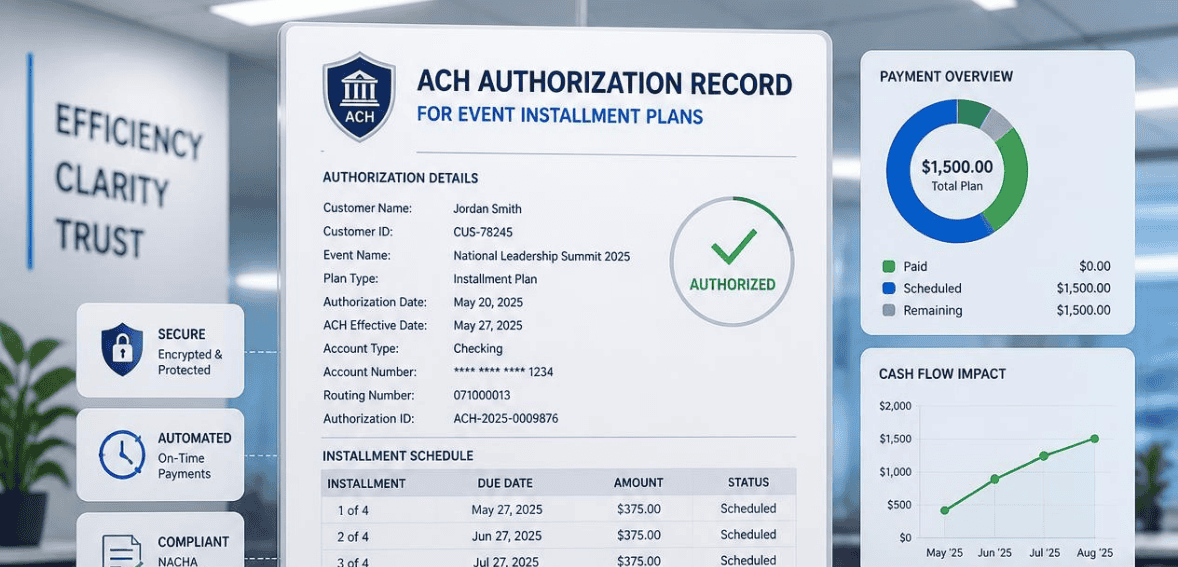
Picture this. A fan buys a $600 festival pass in March for a show that happens in July. She does not pay all at once. Instead, she splits the cost into four monthly payments pulled straight from her checking account. It feels easy for her. Behind the scenes, though, one document can decide whether that arrangement is smooth or risky for the organizer. That document is the ACH authorization record.
If you run events and provide payment plans, you probably won’t want to overlook this record. It serves as the legal foundation of every recurring bank draft. Get the record correct, and you will most likely collect on time with few to no disputes. Get it wrong, and you can most likely lose money and possibly be subject to a penalty for one chargeback. This record explains what an ACH authorization event payment record consists of, how long you have to keep it on record, and the importance of this record.
What Is an ACH Authorization in Event Payments?
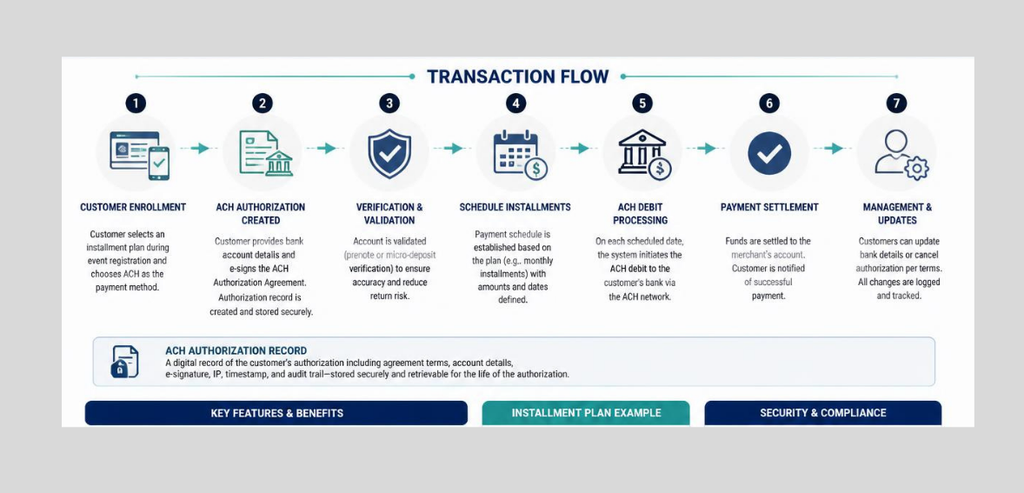
ACH stands for Automated Clearing House. It is the network that moves money between U.S. bank accounts. An ACH authorization is the formal consent a customer gives you to debit their account electronically. Think of it as permission granted in advance.
This is relevant for events when anything on the platform is sold through a payment plan. A deposit for a wedding venue, a ticket for a conference series, a pass for an event series, or a layaway plan for a festival. In all of these cases, you have to be able to pull the money on schedule. If there is an unauthorized pull, it is a problem in the eyes of the ACH Network rules.
An ACH authorization, which is a contract between your business (the originator) and the customer (the receiver), grants your business the right to pull the agreed-upon amount of money at an agreed-upon time. It is also beneficial to the customer because it outlines what the customer is agreeing to. The first document requested when an ACH authorization payment dispute is received is a record of the ACH authorization.
Why Event Organizers Choose ACH for Installment Plans
Card payments dominate quick, low-value ticket sales. But installment plans are a different animal. They involve larger totals collected over months, and that changes the math.
The biggest factor is the cost gap. A 3% card fee on a $500 payment is $15. A flat ACH fee is probably less than $1. Taking that into account, across lots of customers over many months, that gap improves profit margins. Because of that, ACH and recurring payments for retainers, memberships, and payment plans are a good match.
ACH also has an advantage from a customer experience perspective. Users can pay in installments, improving margin for the business and reducing last-minute sales for the event. This is especially the case with crowds like festival-goers who can’t afford the full price up front. They love the event and become guaranteed customers much earlier than before.
The drawbacks are often the timing and returns. ACH payments will clear in batches and thus may take 1–3 business days to officially clear. Drafts can also be returned for insufficient funds. This is why a good authorization practice and a careful retry policy are key.
What a Compliant ACH Authorization Record Must Include
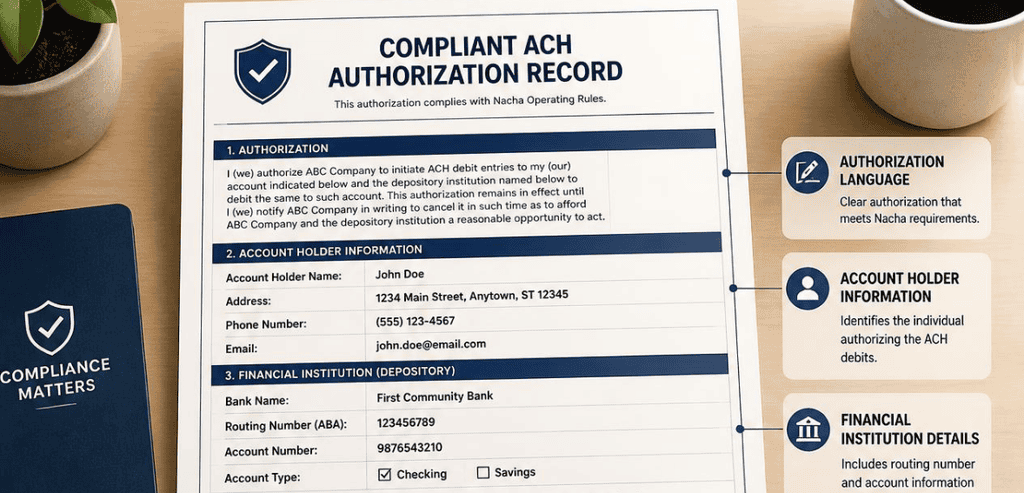
A valid authorization is not a vague checkbox. The National Automated Clearing House Association, better known as NACHA, sets the standard, and event organizers are expected to meet it.
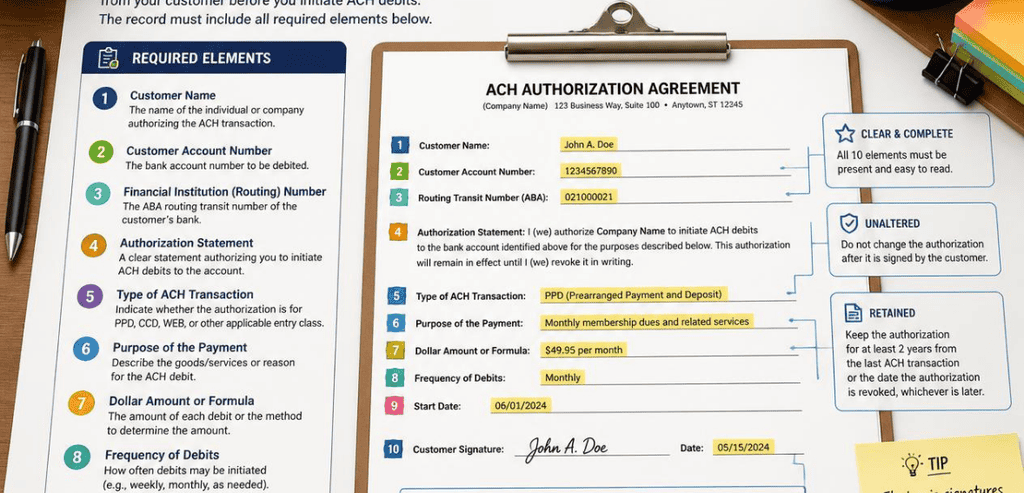
Your record should have clear authorization wording at a minimum. One example is “I authorize [your company] to debit my account”. It must have the amount of each draft and, if it varies, whether it will be a range or maximum amount. It must include wording on the dates and/or frequency of the debits, which for an installment agreement means it has to provide the payment schedule. It also needs the customer’s account number and the bank’s routing number. It also needs to include the revocation wording that lets the customer know how to cancel and how fast you will stop future drafts.
You also need to get basic identity data like the customer’s full name, mailing address, and phone number, so the record is linked to a certain individual. Not having these details can lead to disputes and returned transactions. Having a signed and complete form is your best safeguard. The exact wording of the rule is located in NACHA’s operating rules, which are the only source that has rules for the U.S. ACH.
Authorization Types That Fit Event Installment Plans
Not every authorization looks the same. NACHA recognizes a few distinct types, and picking the correct one for your event payment plan keeps you compliant.
A one-time payment requires a single authorization. A recurring authorization covers payments that are made at a given frequency for the same or similar amount, and requires no further customer action. An example of this would be a four-part monthly ticket plan with fixed amounts. Lastly, standing authorization, a more modern type of authorization between one-time and recurring authorizations, allows a customer to authorize drafts to be made at varying intervals of a customer’s choosing for a series of future payments. Each payment is made after the customer makes a specific affirmative act.
Most event installment plans would typically use a recurring authorization since the schedule and amount are known in advance. Standing authorization would work better for plans that allow customers to make add-on purchases at a later date. Regardless of which type of authorization is used, the customer must agree to the terms of the first payment before it is charged.
How Long You Must Keep ACH Authorization Records
This is where the contract and payment records discipline earns its keep. Collecting the authorization is only half the job. Storing it correctly is the other half.
According to NACHA, each authorization must be retained for at least two years. The countdown begins from the date on which the authorization gets revoked or terminated, or from the date on which the last transaction gets processed, whichever is later. This means holding the record for a festival that ends in July for a couple of years. As events occur on a seasonal basis and disputes can be reported long after the fact, a lot of event organizers keep records for longer than the minimum.
The format of the record retention system you set up is at your discretion, but most teams answer the record retention challenge with a digital system. Encrypted and access-controlled systems with audit logging are great for maintaining the security and searchability of log records. If you must use paper records, utilize locked storage with documented and restricted access. Either way, build an audit trail documenting the date authorizations are received and from whom, as well as any changes to the authorization. A bank can ask for authorization records at any time, so you want to be able to provide records within minutes.
Proof of Authorization and Payment Disputes
Here is the scenario every organizer dreads: A customer forgets they signed up, sees a draft, and calls their bank to dispute it. The bank hands them a Written Statement of Unauthorized Debit, often shortened to WSUD. Once that is filed, the bank may ask you to produce a Proof of Authorization.
You have ten banking days to respond. Presenting a valid authorization, if and when it meets the set criteria, may allow the bank to honor the transaction. Otherwise, you lose the transaction, the funds are recovered, and you could be charged a non-compliance fee.
The risks have increased. Risk management regulations set by NACHA for 2026 mean that adopting poor authorization practices can cause unauthorized transactions to be returned at a higher rate, increase the chance of being held liable for insufficient evidence, and make you more accountable for fraud that is not being proactively addressed.
In this regard, Regulation E also protects consumers by mandating that the consumer’s preauthorized transfer be made after written, signed, or similar authenticated consent is given. You can check the regulatory safeguards at the Consumer Financial Protection Bureau. The main point is simple. Your ACH authorization event payment records are your evidence. Deal with them accordingly.
Tools That Help Manage ACH Authorization Records
You do not have to build compliance from scratch. Several platforms handle authorization capture, storage, and recurring drafts for event teams.
NACHA
NACHA should be noted, but it isn’t a vendor, as they define what a valid authorization is. Addressing their published guidance will benefit you, because if you don’t, there will likely be expensive gaps in your form. Consider NACHA rules the base that all tools and templates must satisfy.
Ticket Fairy
Ticket Fairy is an event ticketing platform with built-in support for installment plans. It automates the payment schedule and sends customer notifications, so organizers do not have to track thousands of individual drafts by hand. For festivals running layaway options at scale, that automation removes a huge manual burden and keeps records consistent.
PDCflow
PDCflow is a payment and compliance platform that focuses on authorization workflows. With PDCflow, organizations can easily capture signatures via the electronic signature service, email signed authorization to customers, send reminders, and send receipts. Much of this sort of automation, where the documentation is generated and stored as part of the payment workflow, simplifies the challenge faced by organizations to meet NACHA record-keeping requirements.
Best Practices for Event Organizers
There are a couple of key differences between people who almost always get their way in payment disputes and people who hemorrhage money. Instead of including “I agree to recurring billing,” include language that describes specifics of the authorization. Include the full schedule and total in the description. Be sure your customers are aware of and not shocked by the totals. Notify customers of all drafts, especially when you have recurring amounts that change before the draft.
Most jurisdictions require advance notification when the scheduled debit amount is not the same. Keep an eye on return rates and use a service provider when needed. You need an automated process to retry and notify your customers of failed payments. The only way to ensure income from signed payment authorizations is to stay organized and immediately accessible.
Conclusion
Event installment plans are a smart way to sell more tickets and welcome more attendees. But the convenience rests entirely on one quiet document. A complete, compliant ACH authorization record is what turns a friendly payment plan into a defensible, revenue-protecting arrangement.
Capture the right details. Use the correct authorization type for your schedule. Store each record securely for at least two years. Respond quickly when a proof request arrives. Do these things, and your ACH authorization event payment process will become a strength rather than a liability. In a world where disputes and fraud rules keep tightening, the organizers who treat authorization records as core contract and payment records are the ones who keep their money and their peace of mind.
Frequently Asked Questions
Do I really need a separate ACH authorization for an event payment plan?
Yes. Every recurring draft you initiate must be backed by a valid authorization. For an installment plan, a recurring authorization that lists the amounts and schedule is usually the right fit. Without it, each debit is unauthorized and can be reversed.
How long do I have to keep ACH authorization records?
At least two years, measured from the date the authorization is revoked or terminated, or from the last payment processed, whichever is later. Because event disputes can surface late, many organizers hold records even longer to stay safe.
What happens if a customer disputes a draft and I cannot find the authorization?
The transaction defaults against you. The bank returns the funds, and you may owe non-compliance fees. This is exactly why fast, searchable record storage matters as much as collecting the authorization in the first place.
Is ACH cheaper than credit cards for event installment plans?
Usually, yes, especially for larger totals collected over several months. A flat ACH fee is often a fraction of a percentage-based card fee, so the savings compound with every billing cycle across your attendee base.